
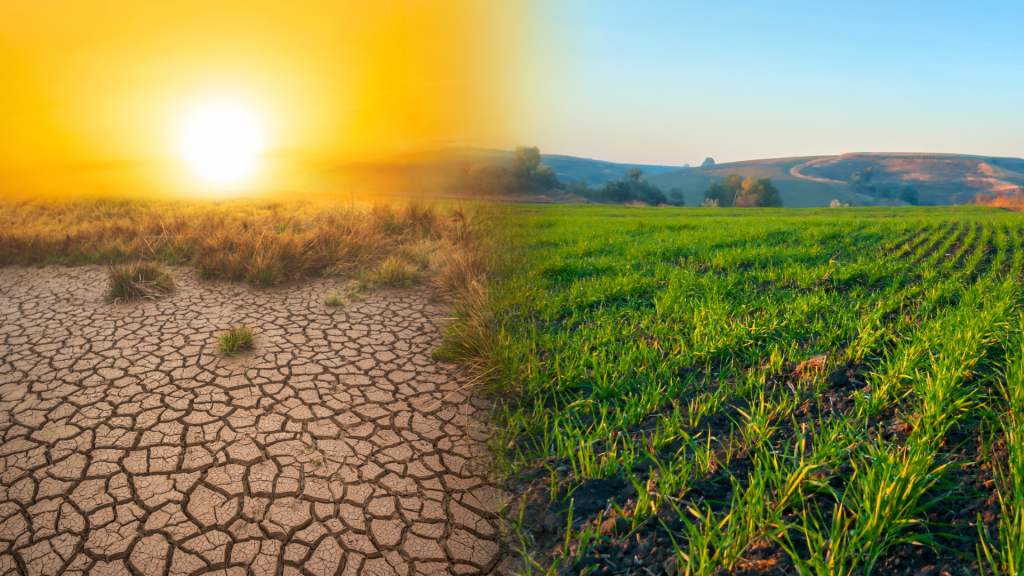
It’s devastating to think that 800 Million people are going hungry every day, while at the same time, we produce enough food that nobody should be going hungry. Further, every year we are wasting a staggering 1.6 Billion tons of food.
By 2050, the world’s population is estimated to go up to just short of 10 Billion. Still, the hard truth is that to maintain a healthy planet, we cannot afford to expand agriculture anymore. We need to find solutions to ensure we are producing food in a means that is efficient and not harmful to our ecosystem.
The reality is that agriculture and the production of food are hurting the planet. In the struggle to feed our growing population, we are ripping down forests and destroying the homes of endangered species. Farming also leads to water scarcity and in the aim to produce food in mass, when harmful pesticides are used, these also release carbon into our environment.
We also have an overreliance on certain foods. 75% of people’s diets are dominated by 12 plants and 5 animal species. This has two major implications – the first is, due to the high demand for these foods, farmers are focusing their crops on these foods but this is resulting in the soils becoming depleted of nutrients as they are over-farmed, and further, especially the poorest amongst us aren’t getting very nutrient-rich balanced diets.
Now, what is the solution – because we need one and we need one fast?
37 world-leading scientists came together as part of the Eat-Lancet Commission on Food, Planet, Health and they found that:
“ Food is the single strongest lever to optimize human health and environmental sustainability on Earth. However, food is currently threatening both people and the planet.”
Eat-Lancet
The commission identified several key areas of focus that need to be addressed so that by 2050 we can sustainably produce enough food to provide a balanced diet to the estimated 10 Billion population:
- We need to start eating less meat and more plants. Increasingly people are shifting to vegetarian or flexitarian diets and the environmental benefits are significant. The contrast in CO2 emissions and water usage of plants vs animal products is significant. Beef produces on average 19.5 kg CO2/Kg emissions compared to the average of 0.7 kg CO2/Kg of vegetables and the production of 1 kg of beef requires a staggering 60x more water than 1 kg of potatoes.

- We need to grow and eat more diverse foods. We need to shift away from the overreliance on a limited number of food groups as it’s both harmful to the planet and also not as nutritionally beneficial. For those individuals excited to explore new foods, this cookbook provides an interesting read into foods for the future that have both health benefits and benefits for the planet.
- We need to use our existing farmland smarter and innovate ways to make food production more sustainable in order to protect our biodiversity. Innovations in the food and farming sector can help drive this change.
- We need to stop food waste – individuals and retailers together need to work towards reducing food losses by 50%. For the big farms and retailers can do this through innovations along the supply chain, while individuals can make continuous efforts to reduce their waste:

Supporting Sources:
How to reduce food waste at home (2021) Eufic. European Food Information Council (EUFIC). Available at: https://www.eufic.org/en/food-safety/article/how-to-reduce-food-waste-at-home (Accessed: March 4, 2023).
The eat-lancet commission on food, planet, health – eat knowledge (2021) EAT. Available at: https://eatforum.org/eat-lancet-commission/ (Accessed: March 3, 2023).
Together we can resolve the nutritional paradox (2022) The Nutritional Paradox. Available at: https://np.thepondfoundation.org/ (Accessed: March 3, 2023).
Sustainable Diet (no date) UN CC Learn. Available at: https://www.unsdglearn.org/courses/sustainable-diet/ (Accessed: March 4, 2023).

 Do More. Technology Re-imagined.
Leave a comment