
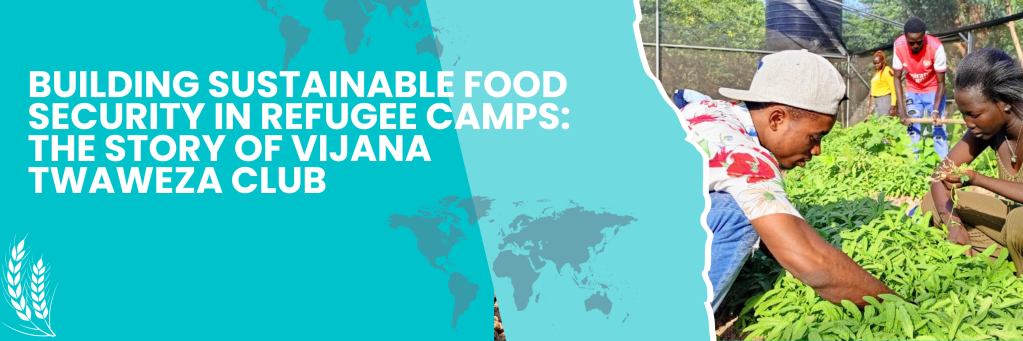
In the face of adversity, there are often individuals who rise above to create impactful, lasting change. One such individual is Wa Luundo, a refugee from the Democratic Republic of Congo, who founded the Vijana Twaweza Club, a refugee-led initiative focused on improving food security in the Kakuma Refugee Camp in Kenya. His journey, which he talks about in the latest episode of ‘The Social Agtech Podcast’, highlights the incredible potential of community-driven solutions in addressing global hunger.
The Genesis of Vijana Twaweza Club
Luundo’s story begins in 2016 when he arrived at Kakuma, fleeing conflict in his homeland. Like many refugees, he was met with the stark reality of life in the camp: limited opportunities for education and employment, and food shortages that left many reliant on meager rations from the World Food Programme (WFP). Faced with these challenges, Luundo was determined to find a solution that could not only support his own wellbeing but also uplift the community around him.
His inspiration came unexpectedly while watering trees near his church. He stumbled upon a fish in the stagnant waters of Kakuma and decided to start fish farming—a rare endeavor in such an arid region. Starting with a single fish, he dug a small pond and began learning the art of fish farming. Soon, local youth joined his efforts, catching fish from seasonal rivers to help expand the farm.
What began as a humble project quickly grew into something much larger. In 2018, Luundo officially founded the Vijana Twaweza Club, which aimed to create sustainable employment opportunities for young people in the camp. The club’s mission was simple yet powerful: use agricultural projects, particularly fish farming, to address food insecurity while also generating income for its members.
Expanding Horizons: From Fish to Community Empowerment
Over the years, Vijana Twaweza Club has expanded its scope far beyond fish farming. Today, the club engages in a range of agricultural activities, including poultry farming, aquaponics, cricket farming, and even black soldier fly farming, which is used to feed fish and poultry. These diverse projects are designed to provide both food and income, not only for the club’s members but also for the wider refugee community.
A key component of the club’s success is its focus on youth employment. As Luundo explains, “It’s all about the youth creating employment for other youth.” The club has trained many young people in fish farming and other agricultural skills, offering them a pathway out of poverty and a means to support their community.
The impact of these efforts has been profound. In addition to providing much-needed food, Vijana Twaweza Club has fostered a sense of hope and purpose in a place where opportunities are scarce. Luundo and his team have also been able to collaborate with organizations like the WFP, Jesuit Refugee Service and the Caritas Italianna, further expanding the reach of their work.
Overcoming Challenges and Looking to the Future
Running a fish farm in a desert presents no shortage of challenges. From managing water quality to dealing with extreme temperatures, the club has had to adapt to the harsh conditions of Kakuma. However, with determination and community support, they have found innovative solutions to these obstacles.
One of the club’s future goals is to implement a recirculating aquaculture system, which would allow them to produce fish year-round, increasing their output and meeting the growing demand for fresh fish in the camp. This system could also serve as a model for other refugee camps and arid regions looking to improve food security.
Despite the difficulties, Luundo remains optimistic. His advice to others facing similar challenges? “Be committed and involve others in what you are doing. Through the process, you are learning.” He emphasizes the importance of community collaboration and the power of small, incremental steps toward achieving big goals.
The Broader Impact: Refugee-Led Solutions to Global Hunger
Luundo’s story is not just about fish farming; it’s about the potential for refugee-led initiatives to contribute to global solutions for food insecurity. In a world where millions of people are displaced by conflict and climate change, the work of organizations like Vijana Twaweza Club offers a blueprint for how communities can take charge of their own futures.
By empowering refugees to develop sustainable agricultural practices, we can not only address immediate food shortages but also create long-term solutions that promote self-sufficiency and economic resilience. Luundo’s journey is a testament to the power of innovation, determination, and the human spirit.
As the world continues to grapple with the challenges of hunger and displacement, the lessons learned from Kakuma could play a vital role in shaping a more food-secure future for all.
This story serves as an inspiration for how individuals, even in the most challenging circumstances, can rise to create positive change. If you want to learn more or support initiatives like Vijana Twaweza Club, consider following their journey and contributing to the development of refugee-led projects around the world.

 Do More. Technology Re-imagined.
Leave a comment