
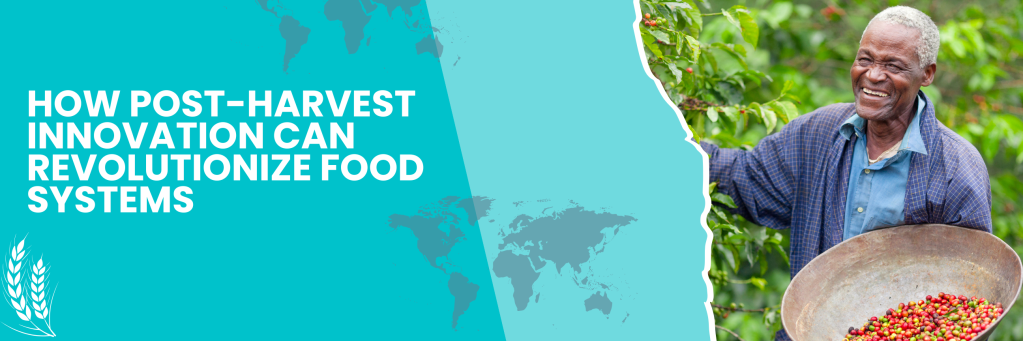
The latest episode of The Social AgTech Podcast dives deep into one of agriculture’s most pressing issues: post-harvest loss. Featuring William Lanier, CEO of NeverIdle Farms and Consulting Limited, the episode unpacks the systemic challenges contributing to food insecurity in sub-Saharan Africa and explores innovative solutions to transform agriculture. For startups, impact investors, and changemakers passionate about combating hunger, this episode offers an unfiltered look into the untapped potential of addressing post-harvest inefficiencies.
In this blog, we’ll delve into key themes from the podcast and explore how innovations like mobile grain storage can reshape global food systems. As William Lanier points out, “Post-harvest loss is not rocket science; it’s a solvable problem.” Solving it, however, requires collective effort, investment, and a shift in priorities.
The Hidden Crisis of Post-Harvest Loss
Food insecurity often garners attention for its visible effects—empty plates and malnourished communities. Yet, the underlying cause is frequently hidden in plain sight: post-harvest loss. This loss isn’t due to a lack of solutions but to structural barriers and market inefficiencies. Lanier explains that in many African nations, farmers lack access to proper storage facilities, leaving their grain vulnerable to pests and weather. “In Canada, grain doesn’t touch the ground. That’s a big difference,” he notes.
Post-harvest loss has far-reaching implications beyond lost food and the resources used to grow and harvest. It depletes water resources, degrades soil, and undermines smallholder farmers’ livelihoods—many of whom are women. 44% of the world’s degraded soils are in Africa (5), leading to inefficient agricultural outputs. More alarmingly, 3,758 square meters of water per ton of maize is lost (3) due to grain rotting in the field, or later on, because of inadequate storage (2).
Mobile Storage: A Game-Changer for Farmers
One of the most compelling solutions discussed on the podcast is mobile grain storage, an innovation championed by NeverIdle Farms. Unlike traditional warehouses, when empty this storage is mobile and can be relocated to where aggregation, storage, monitoring and pest management is needed – notably this can be done at a time where primary processing is optimal. The impact of this and the benefits of storing grain off the ground at optimal locations along the supply chain directly unlocks the ability for farmers to earn more for their harvest as the owner can negotiate transport of the contents to any market after price increases and before price decreases.
Lanier shares a powerful insight: “Overnight, mobile storage assets gives a woman harvest tenure. They can wait, negotiate fair transport, and move grain to the market when prices are better.” By empowering smallholder farmers with mobility and control, these bins offer a practical and scalable solution to post-harvest challenges.
For women in northern Ghana, where land ownership is often unattainable, mobile storage provides a lifeline. It enables them to store surplus, manage grain quality, and price appreciation to increase their income. Additionally, the bins allow for daily monitoring, helping farmers prevent pests and maintain grain quality.
Beyond Technology: The Need for a Systems Approach
While mobile storage is transformative, technology alone cannot address the complex web of issues contributing to food insecurity. The podcast underscores the importance of systemic change, particularly in how agricultural development is approached.
Many interventions focus solely on production, ignoring the post-harvest stage. Studies reveal that nearly 90% of agricultural solutions target production tools like fertilizers, seed and pesticides (4), neglecting storage and transportation. Lanier warns, “Do not confuse production with yield of nutrition. Increased production means nothing if food rots before reaching the consumer” (1).
A shift toward phygital solutions—a blend of physical infrastructure and digital capabilities focused around allocation—is essential. For example, digital apps that connect farmers to credit for inputs should integrate storage and pest management capabilities to ensure food security beyond the harvest.
Policy and Market Barriers
The episode also highlights how entrenched political and market dynamics hinder progress. Large-scale warehouses often fail to serve smallholder farmers, and policy decisions sometimes prioritize maintaining low domestic food prices over supporting farmers with better storage solutions.
In India, for instance, historically surplus grain rots because the government has discouraged private storage to control market prices. Similarly, in Ghana, political resistance to mobile storage stems from fear of disrupting existing warehouse systems. Lanier observes, “Post-harvest loss is profitable for a selfish few at the expense of millions.”
Lessons for Startups and Investors
For startups and entrepreneurs, the podcast offers a valuable takeaway: focus on solutions that yield nutrition rather than simply increasing production. Lanier advises, “The acid test is whether a project substitutes imports with nutrition. If not, it’s just production.”
Impact investors and philanthropists should recognize the long-term value of investing in post-harvest solutions. While these innovations may lack the immediate appeal of cutting-edge technologies, their impact on food systems and livelihoods is profound.
A Call to Action
Addressing post-harvest loss requires a collective effort from innovators, policymakers, and investors. The solutions exist, but their implementation hinges on collaboration and a shift in priorities. As highlighted in The Social AgTech Podcast, it’s time to move beyond production-centric approaches and embrace holistic solutions that secure food from field to fork.
References
- CNBC Africa on post-harvest challenges
- Nature: Addressing post-harvest loss
- Practical Action Publishing on food loss
- Ceres2030 on agricultural practices
- Gates Foundation on soil degradation
Disclaimer
This blog is for informational purposes only and does not constitute financial or investment advice. dmtr does not provide guidance on specific investment decisions or guarantee outcomes based on the information presented.


 Do More. Technology Re-imagined.
Leave a comment