
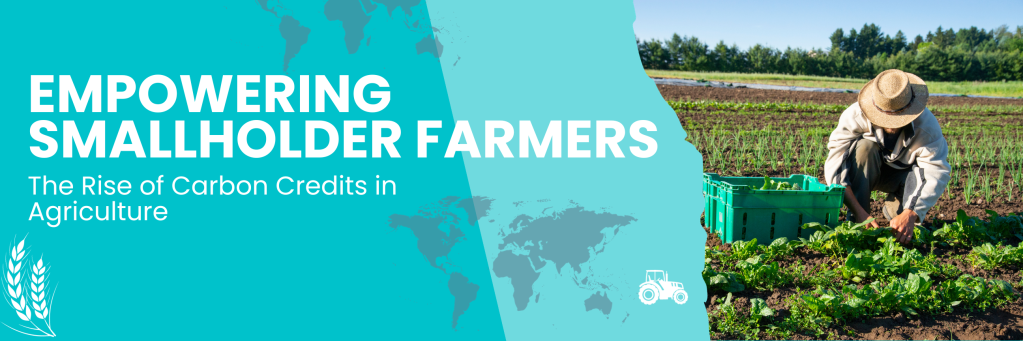
Imagine millions of small-scale farmers across Africa and Asia being paid—not just for what they grow, but for how they grow it. Techniques as old as mulching and tree planting could suddenly generate real income, while also protecting the planet.
This is the promise of carbon credits in agriculture. But for now, the system is failing the farmers who could benefit most.
Can we flip the script—and ensure smallholders aren’t left behind in the new climate economy?
So, What Exactly Are Carbon Credits?
Carbon credits are a way to put a price on climate action. One carbon credit represents one tonne of carbon dioxide (CO₂) removed from or avoided being released into the atmosphere.
In agriculture, which today contributes almost a quarter of global greenhouse gas emissions, this can be achieved through regenerative practices including growing cover crops, reducing methane emissions, planting trees and storing carbon in soil.
When these practices are measured and verified, the resulting credits can be sold to companies or individuals who are seeking to offset their own emissions. The idea is simple: those who reduce emissions get paid by those trying to balance their carbon footprint.
In theory, this could unlock a new revenue stream for farmers but in practice, without the knowledge and scale this is a very difficult market to access and smallholder farmers who lack both of these things face huge barriers to entry.
A Growing Global Market – But Who Benefits?
The voluntary carbon market has grown into a multi-billion-dollar ecosystem, with agriculture and soil carbon playing an increasingly central role. From India to Kenya, carbon credits earned through sustainable farming practices—such as agroforestry (making trees part of a regenerative farming ecosystem), conservation tillage (farming with no or minimal plowing), and biochar (adding charcoal to soil to store carbon)—offer a potential lifeline to smallholder farmers facing climate risks and income insecurity.
But while large farms in the Global North increasingly benefit from this transition, smallholder farmers in Africa and Asia remain largely underrepresented. The opportunity is real—but so are the challenges.
Why Focus on Africa and Asia?
Well, simply it is home to over 80% of the world’s smallholder farmers, many of who operate close to the poverty line with minimal income security, driven by operating in regions that today are most vulnerable to climate change impacts. These regions also offer sites of significant carbon sequestration potential via nature-based solutions with high potential for co-benefits like food security, biodiversity, soil health.
What this means is empowering smallholder farmers in these regions to access carbon credit markets could lead to both climate impact and livelihood transformation. But doing so requires addressing structural barriers, building trust, and creating real incentives as when structured fairly, carbon credits can provide these smallholder farmers wiith:
- Additional income through climate-smart practices like agroforestry, cover cropping, or reduced methane rice farming
- Improved soil fertility and yields via regenerative methods
- Access to premium supply chains that reward sustainability
- Greater resilience to climate shocks, pests, and droughts
- Stronger bargaining power when aggregated through cooperatives or verified platforms
Challenge: What’s Blocking Participation?
Despite these opportunities, smallholders face significant hurdles to be able to come close to realising them:
- High costs of verification and monitoring (MRV) often make participation unaffordable.
- Complexity and lack of awareness make it hard to understand how carbon markets work.
- Market volatility and lack of price guarantees leave farmers exposed to risk.
- Power imbalances in credit ownership and benefit sharing often leave farmers with a fraction of the earnings.
Unless these issues are directly addressed, carbon credit systems risk repeating the patterns of past agricultural interventions, leaving those for which this represents the greatest opportunity no better off than they are today.
What Needs to Happen to Incentivize Sustainable Farming?
Despite these challenges, across Africa and Asia promising initiatives are beginning to show how carbon markets can work for smallholder farmers. In India, Kenya, and Ghana, Boomitra is using satellite-based monitoring to link over 150,000 smallholders to an estimated $200 million in carbon finance. Meanwhile, Google’s 2025 purchase of biochar credits from Indian farms highlights how multinational interest is helping to scale low-tech carbon solutions. In Uganda and Zambia, new agroforestry programs are empowering youth and women’s cooperatives to lead local carbon projects, offering both environmental and economic benefits. And at the 2025 Africa Climate Summit, governments across the continent pledged to support homegrown carbon markets and ease regulatory barriers to help smallholders participate.
Lessons learnt from these successes, as well as the failures of other efforts, highlight that to turn carbon credits into a real incentive for smallholders in Africa and Asia, a considered approach needs to be taken, with a focus across the five following areas:
1. Make Carbon Programs Farmer-Centric
- Design projects with farmer input, not just for them.
- Ensure fair revenue sharing with transparent benefit distribution.
- Use cooperative models to boost collective bargaining and reduce individual risk.
2. Simplify Verification Through Innovation
- Use satellite imagery, remote sensing, and AI to reduce verification and monitoring costs (e.g., Boomitra, Agreena).
- Provide mobile-based tools for self-reporting and education in local languages.
3. Provide Upfront Incentives
- Offer seed funding, equipment, or inputs to adopt new practices.
- Use results-based finance to reward adoption before full credit issuance.
4. Aggregate and De-Risk Participation
- Support the formation of aggregator organizations or NGOs that bundle smallholders together.
- Create blended finance mechanisms to share risk between farmers, buyers, and donors.
5. Align Carbon Programs with Local Priorities
- Integrate carbon credit activities with food security, water access, and local market improvements.
- Respect traditional land rights and ensure gender inclusion in participation.
The Path Forward
Carbon markets alone will not solve poverty or food insecurity. But when designed inclusively, they can tip the scale toward more resilient and sustainable agriculture in Africa and Asia.
The priority now must be to democratize access, reduce participation costs and Support local leadership and innovation. If these steps are taken, smallholder farmers will not only be passive participants—they’ll be leaders in the climate solution.

 Do More. Technology Re-imagined.
Leave a comment