
Author: Evelyn Miria Sani
Introduction
Post-harvest loss (PHL) remains one of the most persistent and solvable failures in the global food system. According to the Food and Agriculture Organization of the United Nations, an estimated 13.3% of food is lost between harvest and retail each year. Broader assessments suggest that nearly 30% of global food production roughly 1.3 billion tonnes are lost or wasted annually. Despite international commitments to halve food loss by 2030, progress is off track.
The 2025 edition of the Global Report on Food Crises (GRFC) shows conflict, economic shocks, climate extremes and displacement continued to intensify hunger worldwide. In 2024 alone, more than 295 million people across 53 countries faced acute food insecurity, 13.7 million more than the previous year.
In many of these regions, agriculture is the backbone of livelihoods. Yet significant portions of what farmers grow never reach consumers. PHL erodes incomes, weakens national economies, reduces food availability, and drives up prices disproportionately affecting low-income households. In parts of Sub-Saharan Africa, where agriculture contributes a substantial share of GDP, persistent losses have turned former exporters of staple crops into net importers.
PHL is not simply a technical inefficiency. It is a structural economic and humanitarian challenge, and a major opportunity for innovation.
Understanding the Problem
Losses vary by commodity and region. The highest percentage of global food loss is in sub-Saharan Africa (21.4%), followed by eastern and south-eastern Asia (15.1%) and northern Africa and western Asia (14.8) (Fig 1). The diverse nature of commodities presents unique challenges, complicating the issue. PHL in sub–Saharan Africa region often ranges from:
20–50% for roots and tubers
30–50% for fruits and vegetables
10–40% for grains
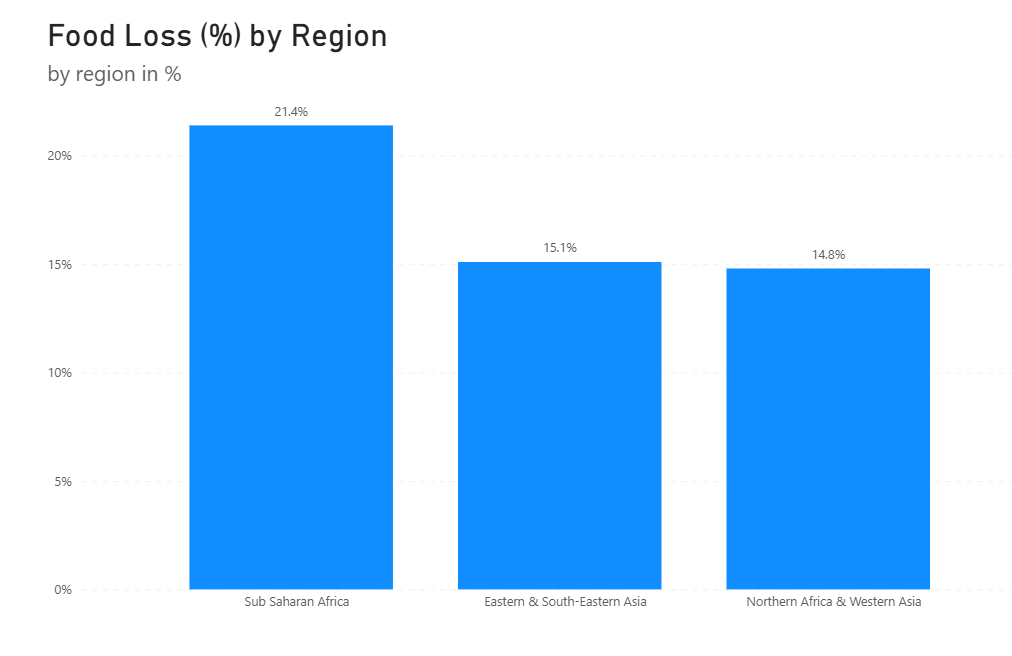
Fig:1 Source: SDG 12 HUB, 2024
PHL is a significant issue in developing economies and four systemic weaknesses contribute to the problem.
1. Inadequate Storage: Many smallholder (peasant) farmers lack access to safe, durable storage. Crops are frequently kept in open sheds or woven sacks, exposed to pests, rodents, moisture and extreme temperatures. Without silos, hermetic systems or moisture control, grain and root crop losses alone can reach 20–40%.
2. Weak Cold-Chain Infrastructure: In many developing economies, 30–40% of fruits, vegetables and dairy products spoil before reaching consumers due to insufficient refrigerated storage and transport. Intermittent electricity and high equipment costs make conventional cold chains difficult to sustain.
3. Poor Transport and Logistics: The time between harvest and market is decisive. Bad roads, fragmented supply chains and logistical bottlenecks mean large quantities of produce cannot survive long-distance travel. In some African markets, transport-related inefficiencies alone account for losses exceeding 30%.
4. Limited Market Access: Without reliable buyers, farmers frequently sell to intermediaries at depressed prices or hold produce longer than optimal. Delays increase spoilage risk and weaken bargaining power. Across Africa and Asia, smallholders remain disconnected from structured markets and transparent pricing systems.
Why So Many Interventions Fall Short
Over the past decade, governments, research institutions and development agencies have introduced policies and technologies to reduce post-harvest loss. Yet impact has often been limited.
Policy frameworks in countries such as Nigeria and Tanzania have emphasised boosting production, while underinvesting in post-harvest systems. Continental commitments led by the African Union have set ambitious targets, but implementation and monitoring remain uneven.
Research bodies including the International Food Policy Research Institute have generated valuable evidence on improved storage and handling technologies. However, adoption is frequently constrained by high upfront costs, limited training, weak infrastructure and maintenance challenges.
Even promising tools, such as hermetic storage bags (an airtight, moisture-proof, multi-layered bag which prevents insects from consuming grain by creating low-oxygen environment) and solar dryers (a technology that reduces moisture from produce to prevent mould and rot) struggle to scale sustainably when introduced without financing mechanisms or local service ecosystems. Large cold-chain installations (cold rooms, warehouse) often falter due to unreliable electricity and insufficient technical support. When these innovations have failed to solve post-harvest loss in developing countries, it is not due to inherent technical flaws, but rather socio-economic barriers, infrastructure deficits and high maintenance requirements. The lesson is clear: technology transfer alone is not enough. Solutions must be affordable, locally adaptable and commercially viable.
Proof That the Model Can Work
Encouragingly, several companies demonstrate that tackling PHL can be both impactful and profitable.
- ColdHubs in Nigeria provides solar-powered walk-in cold rooms in markets and farming communities, allowing farmers to store fresh produce using a 24/7 pay-as-you-store system. This service helps smallholder farmers keep their fruits and vegetables fresh for longer, reducing spoilage after harvest.
This solution has had a strong positive impact on local agrifood systems. PHL is down by about 80%, allowing farmers to sell more of their produce and increase their income. The success of ColdHubs has received international recognition. In 2022, it won the Food Planet Prize and received $2 million USD for its innovative and sustainable contribution to improving food systems.
- Silo Africa in Kenya helps smallholder farmers reduce crop losses by providing solar-powered airtight storage systems and connecting them to premium buyers through digital trading platforms. This solution allows farmers to store grain safely for longer periods and sell when market prices are better.
Silo Africa has made a significant impact reducing PHL by up to 40%, helping farmers protect more of their harvest as well as improving food security and raising household income. The organisation has deployed over 500 Smart-Silos, creating around 25,000 tonnes of grain storage capacity.
The project has reached more than 3,200 households, while crop productivity has increased by about 45%. The impact of Silo Africa has also been recognised internationally. The organisation received the Bayer Foundation Women Empowerment Award, which included a €25,000 (about $29,000 USD) prize for its contribution to empowering women farmers and strengthening sustainable agriculture.
- S4S Technologies in India is transforming the way smallholder farmers handle surplus produce by using solar-powered conduction dryers. These dryers convert excess fruits and vegetables into shelf-stable products, helping farmers reduce waste and earn more income.
This approach has had a measurable impact on rural communities. Over 100,000 smallholder farmers have benefited, earning 10–15% higher profits. More than 2,000 women micro-entrepreneurs have seen their incomes double or even triple. The dryers prevent around 40,000 tonnes of food waste annually, while saving over 485,000 metric tonnes of CO₂ emissions, contributing to environmental sustainability.
The company’s innovation has also earned it multiple awards and international collaborations, recognising its contribution to sustainable agriculture and food systems
- Tropical Snacks in Ghana helps smallholder farmers by transforming perishable crops like plantain and cocoyam into value-added consumer products. This approach stabilises demand for farmers’ produce, reduces waste and creates reliable income streams. Evidence of impact includes:
- Reduced post-harvest losses – allowing more produce to reach consumers instead of spoiling.
- Job creation for women and youth – providing employment opportunities in processing and distribution.
- Stable income for smallholder farmers – improving livelihoods and supporting rural communities.
By adding value to locally grown crops, Tropical Snacks contributes to food security, rural empowerment and aims to bring African products to global markets, showcasing sustainable and profitable agriculture.
- Twiga Foods Kenya is an agri-tech company that is revolutionising food distribution by connecting farmers directly to vendors. Their platform links over 17,000 farmers with over 8,500 daily food vendors across Kenya, optimising logistics and reducing spoilage through real-time demand matching. This direct connection has significantly cut food waste, showcasing the impact of innovative solutions in agriculture. The company have just raised $30 million USD in Serie B funding from Goldman Sachs to fund their international expansion plans. Amidst a rising tide of agri-tech and digital marketplace apps for farmers, there is a consensus within the ecosystem that Twiga is the market leader who might just master food distribution across sub-Saharan Africa.
These ventures succeed because they align incentives: farmers reduce losses and increase income, while startups build sustainable revenue streams.
High-Potential Areas for Innovation
The greatest opportunity lies in the “first mile” — immediately after harvest. High-impact startup pathways include:
- Off-grid cold storage: Modular, solar-powered, pay-per-use systems tailored to rural contexts.
- Intelligent packaging: Biodegradable materials with ethylene absorbers or embedded sensors to extend shelf life.
- Localised processing: Small-scale facilities for drying, milling, pulping or fermenting surplus crops during peak harvests.
- Data-driven logistics: AI-enabled demand forecasting and route optimisation to shorten time-to-market.
- Affordable hermetic storage: Scalable airtight solutions protecting grains without chemical preservatives.
- Edible coatings: Organic barriers derived from chitosan or plant extracts to slow spoilage in high-value crops.
- Digital Marketplace platform: Connecting farmers directly to buyers, shortening supply chains and improving forecasting.
- (IoT) (smart farming): Optimizing logistics through smart tracking, dynamic pricing and inventory management.
Each solution addresses inefficiencies not at the point of production, but at the point where value quietly disappears.
The Stakes
Reducing post-harvest loss delivers compound returns.
- Food security: In Sub-Saharan Africa alone, annual losses are valued at roughly $4 billion USD, enough to feed tens of millions.
- Economic resilience: Smallholders can lose up to 15% of annual income due to spoilage.
- Climate mitigation: Food loss accounts for up to 10% of global emissions and wastes approximately a quarter of agricultural water use.
Consumer stability: Reduced spoilage helps stabilise food supply and moderate price volatility.
A Problem Worth Solving
The world does not only need to grow more food; it needs to lose less of what it already produces.
Post-harvest loss sits at the intersection of climate, poverty, food security and entrepreneurship. Unlike many global challenges, the technologies to address it largely exist. What remains is the task of redesigning them for affordability, accessibility and scale.
For startups seeking measurable impact and durable markets, post-harvest loss is not merely an agricultural issue. It is one of the highest-impact opportunities of our time.
References
Muganyizi, J., Bisheko, G., Reji, Kumar., (2024) Mitigating postharvest losses: A policy-driven approach to empowering smallholder farmers in Tanzania, Scientific African, Volume 23 (e02119). https://doi.org/10.1016/j.sciaf2024.e02119
Jarman, A., Thompson, J,. et al. (2023) (September update): FSIN and GNAFC. 2025. GRFC 2025.September Update Rome https://doi.org/10.71958/wfp131041
Food loss and waste account for 8-10% of annual global greenhouse gas emissions; cost USD 1 trillion annually. UN Climate Change News 30 September 2024 (https://unfccc.int)
SDG 12 HUB, (2024). Target 12.3 Food loss and waste. https://sdg12hub.org/sdg-12-hub/see-progress-on-sdg-12-target/123-food-loss-waste

 Do More. Technology Re-imagined.
Leave a comment