
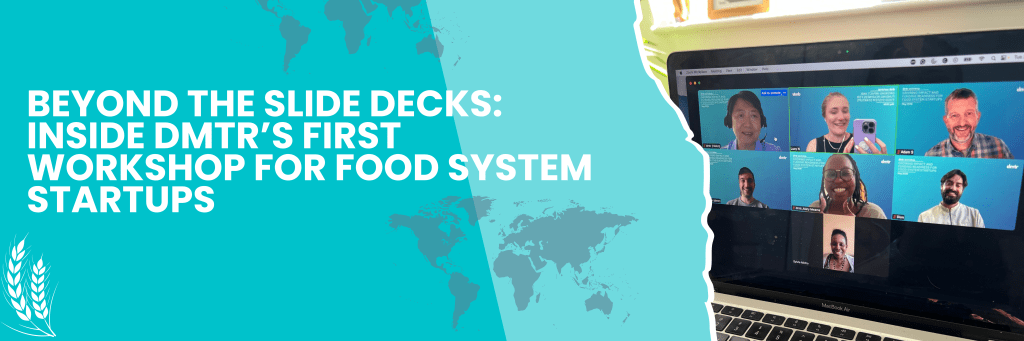
By Mary Mwema, Dion McDougal, Adam Steinberg, Siphosami Nyembe, Arian Ataie
Across Africa and Asia, brilliant young innovators are building grassroots solutions to end hunger in their communities—tackling everything from post-harvest food waste to low farmer yields and fragile supply chains. Yet, operating in these complex contexts with limited resources can often feel deeply isolating. Founders regularly struggle against scarce capital, rigid funding requirements, and a lack of practical guidance on how to prove their impact.
To bridge this gap, dmtr hosted its inaugural three-day virtual workshop series in May 2026. We designed the programme around three interconnected themes that food system entrepreneurs continually bring to us: growing impact, measuring it credibly, and communicating it in ways that unlock growth capital.
Bringing together startups from across Africa, expert speakers from global institutions, and a dedicated team of volunteers, this milestone quieted our own doubts about what dmtr could achieve. Here is our honest, collaborative story of how we moved from vision to practice—and how a cohort of courageous founders refined their mission to feed the future.
The Anatomy of a High-Stakes Launch
Every workshop has a story that begins well before the first slide is opened. For our volunteer team, the primary challenge was translating an ambitious vision into a high-touch, practical experience that reached the founders who needed it most.
Mary, a core member of the organizing team who led curriculum development, remembers the initial mix of excitement and anxiety during the planning phase. While she could easily “visualise the engagement in the room” as facilitators guided breakout sessions, a central question kept her up at night: “Where are all those participants coming from?” Her worries dissolved as the mobilization effort kicked into gear. Thanks to targeted social media outreach from the Communications team and extensive network reach, the virtual room filled beyond expectations with “an impressive average of 28 virtual participants per call!”
Orchestrating an international event across multiple time zones required extreme organizational agility. Rather than treating the agenda as fixed, the team were quick to respond to how the sessions were going and adapt in real time. Adam, one of the session facilitators, highlighted how much he “appreciated the agile mindset of the organisers” as real-time tweaks to introductions and breakout assignments were “immediately addressed and changes made”. Dion, another session facilitator, noted that moving the workshop from idea to reality was defined by “open check-in points and with ample room for feedback,” with dmtr ensuring the final workshop structure took the best learning and feedback from its target audience and experienced volunteers.
Inside the Virtual Room (The Three-Day Arc)
Running an intensive programme for entrepreneurs juggling businesses and personal responsibilities is no small feat. We structured the three days around actionable business breakthroughs:
Day 1: Growing Impact and Funding Readiness: Demystifying what funders look for and helping startups position their business models for growth capital.
Day 2: Measuring and Communicating Impact: Unpacking Monitoring & Evaluation (M&E) and Theory of Change so founders can credibly prove their outcomes.
Day 3: Attracting Funding: Navigating sector risk profiles and funding structures without compromising organizational mission.
The atmosphere in the virtual rooms was instantly charged with high energy. Mary recalls feeling an immediate wave of excitement on opening morning as everything moved seamlessly, observing that participants eased into breakout discussions “hungry for information,” which provided “pure validation: What we are doing here is solving tangible problems.”
Real Stories of Refinement
For Mary, the true power of the curriculum hit home when watching Kirubel, a founder she had previously supported, narrate the journey of his enterprise, Beta Blockers. Watching his growth on screen was living proof that “refinement is the reward for consistency in entrepreneurship.”
That same drive for refinement echoed through the cohort. Founders from MavunoFresh Hub in Kenya, who support smallholder mushroom farmers, gained “clear direction on what actually goes into my lean canvas model” alongside “industrial insight into what the funding sector/world looks like.” At the Grace Centre for Women Development, the funding readiness sessions helped the leadership team pick out the most relevant problems they solve and “weave it into a one-minute elevator pitch,” adding immediate clarity to their mission. For Kakuma Social Agri-Ventures, learning to measure outcomes and outputs gave them a practical, fresh perspective on the business model canvas.
Community Beyond the Classroom
Bringing these innovators together revealed a deeper reality: founders were hungry not just for theory, but for peer connection. Adam observed that breakout spaces quickly became vibrant hubs where participants seemed “desperate just to talk about their initiatives” and get recognition from both experts and peers. Even when navigating patchy WiFi connections across the continent, steady behind-the-scenes coordination kept the flow smooth.
This peer-to-peer bond extended far beyond the scheduled sessions. The founder of MavunoFresh Hub connected directly with another participant, sparking conversations on how to “collaborate and essentially leverage each other’s skills and expertise to expand and grow.” Similarly, the team at Help Empower Refugees (HER) in Kenya, running poultry training for women in the Kalobeyei Settlement, found immense value in “engaging with other founders and learning from their experiences and challenges” while identifying crucial gaps in their own business validation.
The Invisible Infrastructure
The debrief calls, the group chat voice notes, and the quiet sense of shared purpose—this is where dmtr’s culture lives. Behind every live session were days of invisible prep work, ensuring every slide directly addressed the lived realities of African food system innovators.
For volunteers like Siphosami, who led content curation and template design behind the curtain, the true impact was visible in the meticulous preparation. Coming into the process to synthesize speaker decks and participant feedback, Siphosami was struck by “how much founders were asking for practicality, not theory.”
Even without sitting in on the live calls, Siphosami spent hours studying every single founder’s background to ensure the session templates were tailored to their needs. Recognizing that food system founders are juggling immense operational demands, Siphosami noted that “if the workshop wasn’t clear, concise, and immediately useful, they wouldn’t show up.” The steady attendance proved that this invisible coordination paid off, making three complex hours look entirely seamless.
What We Learned & What We Are Building Next
We set out to host a workshop series and ended up proving something vital: dmtr has the capacity, network, and commitment to drive tangible funding readiness for food system entrepreneurs.
True to our culture of continuous improvement, our team actively evaluated where we can expand. Dion highlighted that while the presentations were of consistently high quality, future iterations will put even more focus on “facilitated discussions, group exercises, and other interactive elements that allow participants to engage more openly.”
We are already integrating these insights into our next workshop design, expanding participatory group exercises so founders leave with fully finalized pitches, M&E frameworks, and donor presentation decks. The future of food security will be built by courageous local founders willing to solve complex problems. At dmtr, we are committed to standing alongside them with practical tools, capital pathways, and an enduring community.
Join Us in Scaling What Works
Whether you are building a startup, leading an impact foundation, or looking to contribute your expertise, there is a place for you in the dmtr ecosystem.
For Entrepreneurs: Are you building a social enterprise to address hunger in your community? [Sign up here to join our founder network and get early access to our next cohort].
For Sponsors & Funding Partners: Help us scale our direct support to high-impact founders across Africa and Asia. [Partner with us / Contact hello@dmtrfood.org].
For Experts & Volunteers: Join a passionate, global team driving grassroots innovation in food systems. [Apply to volunteer with dmtr].
About dmtr
dmtr is a non-profit organisation helping people build solutions to some of the biggest challenges in food—from food waste and farmer incomes to food access and sustainability. We bring together founders, experts, and partners to share knowledge, support innovation, and help create better food systems for the future.
Email: hello@dmtrfood.org
Website: https://dmtrfood.org/
LinkedIn: dmtr

 Do More. Technology Re-imagined.
Leave a comment