
Author: Evelyn Miria Sani
The global food system is currently navigating a period of unprecedented volatility. While global hunger has slightly declined to 7.8% of the population, this progress is fragile and uneven (SOFI 2026 Report). In Africa, the situation is worsening, with 66.6% of people unable to afford a healthy diet (UN Report). The last few years have shown us how interconnected our food system is. COVID-19, the war in Ukraine and tensions in the Middle East have disrupted key trade routes like the Strait of Hormuz. The result? Higher energy and fertiliser prices. And as UN Trade and Development (UNCTAD) warns, that means food gets more expensive and the cost of living keeps climbing. These shocks have exposed the weakness of our “just-in-time” global networks, leading many to ask: is the future of food security found in local supply chains?
What is a decentralised food system?
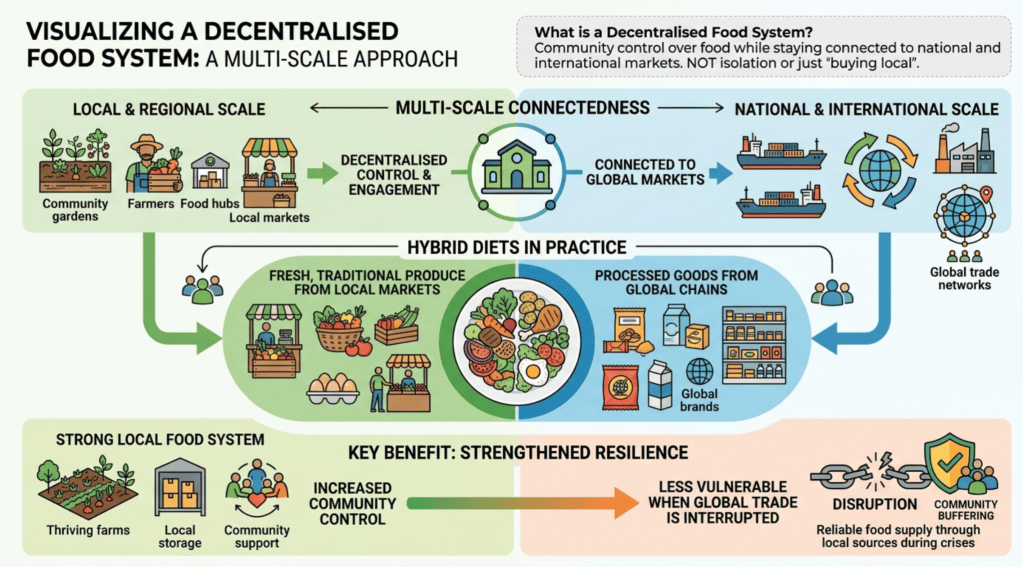
It is a common mistake to think decentralisation simply means isolation or “buying local.” Instead, it is a multi-scale approach where communities take more control over their food while staying connected to national and international markets. In practice, this creates “hybrid diets”, which means combining fresh, traditional produce from local markets with processed goods from global chains. Strengthening the local parts of this system makes communities less vulnerable when global trade is interrupted.
The “Missing Middle”: Fixing the gap between farm and table
One of the biggest hurdles to affordable food is the “Missing Middle”. This refers to the midstream segment or critical portion of the food supply chain, comprising processing, logistics and wholesale activities that bridges the gap between where food is grown and where it is eaten. This critical section of the value chain often lacks adequate data, infrastructure and measurement, making it a “black box” in many national food system plans.
To build a truly secure food system, we must move beyond uniform solutions and instead implement targeted strategies to repair these midstream weaknesses.
Addressing midstream vulnerabilities through decentralised solutions directly lowers cost and strengthens local food security:
- Optimising midstream costs: One major reason food prices are high is that between 70% and 75% of what consumers pay is determined after the food leaves the farm, in processing, transport, storage and retail (SOFI 2026 Report).
- Preventing post-harvest loss: Approximately 1.3bn tonnes of food are lost or wasted globally each year, mostly during intermediate transport and storage. In lower-income regions, a local cold-chain storage and refrigerated transport causes perishable produce to spoil before ever reaching the market.
- Deploying renewable food hubs: Localised food hubs bridge these infrastructure gaps by aggregating output from smallholders into efficient, single deliveries. Integrating decentralised renewable energy — such as solar-powered cold storage, solar dryers or biogas mills — can reduce post-harvest losses by up to 55% while cutting fuel costs.
The SOFI 2026 Report shows that in Sub-Sahara Africa and South Asia nearly 40% of what we pay for food piles up after the farm – in processing, storage and getting it to market. Fixing inefficiencies in this “midstream” is actually the fastest way to make healthy food more affordable. Roughly 1.3bn tonnes of food are lost or wasted every year, with a staggering amount of this loss occurring during the middle stages of the chain. In low-income regions, food is often lost because there is no local infrastructure such as refrigerated transport or post-harvest storage to keep produce from spoiling before it reaches the market (IRENA). Local food hubs address these gaps by providing the shared infrastructure and coordination that individual small-scale producers lack. By using decentralised renewable energy, such as solar-powered mills, hubs can reduce post-harvest losses by 55% (IRENA). These hubs also consolidate produce from many small farms into single, efficient deliveries which significantly reduces the fuel usage and transport costs that typically inflate retail prices.
The Power of Trust: “Relational resilience”
Local supply chains are often more resilient than global ones because they are built on relationships rather than just transactions. In these systems, food is not just a commodity to be traded, it is a shared resource managed by people who know and support each other. This matters because globalised supply chains are built for efficiency but are often incredibly rigid. When a major shock occurs, such as a pandemic or a regional conflict, these distant networks can snap because they lack the social flexibility to adapt.
In contrast, local supply chains are socially embedded, meaning they are held together by systemic glue: trust and mutual assistance. This social connection allows local actors to coordinate quickly, sharing information and resources to keep food on the table when global routes are blocked.
Relational resilience operates across three distinct stages, proving why decentralised networks often outmatch rigid global supply chains during a crisis:
- Absorb and adapt: Rather than shutting down or inflating prices during sudden market shocks, local actors leverage social trust to share transport, pool storage and coordinate pricing, keeping basic foods accessible to neighbouring communities.
- Transform system structures: Instead of attempting to return to vulnerable, pre-crisis conditions, resilient local networks move. They eliminate unreliable intermediaries through direct-to-consumer channels, keeping more value within local economies.
- Empower marginalised groups: Relational networks prioritise social inclusion, securing reliable market access for smallholders and youth who are frequently excluded by large industrial buyers.
When a crisis like rapid inflation hits, local farmers and retailers do not just raise prices or stop operating. Instead, they use social networks to collectively tackle rising costs by sharing resources, such as transport or storage. They also implement cooperative agreements to align pricing strategies, ensuring the market remains stable and food stays affordable for their neighbours. Unlike global models that try to return to their old ways, resilient local systems use shocks as a catalyst to move. By bypassing unreliable intermediaries through direct sales, farmers capture the full retail margin rather than a fraction of it, allowing income that would have leaked to distant aggregators to be retained and recirculated within the farming community itself. Relational resilience is strongest when it is inclusive. The networks provide better market access for smallholders, women and youth who are often overlooked by large industrial buyers (Muna Abdulkareem, Alsoussi A and Shbikat N).
The Environmental Reality: Beyond food miles
A popular myth is that “local” is always better for the planet solely because food travels shorter distances. In reality, transportation typically accounts for only 5% of global food emissions. How the food is produced (such as land use and fertiliser) usually matters more (Hannah Ritchie., et al).
However, when transport is organised locally, the gains are impressive. A study in Galicia, Spain, found that regional supply chains generated 90% lower transport-related emissions than conventional long-distance chains (Alejandro Martinez-Verez, Christina L). The real environmental potential of decentralisation lies in “innovation by subtraction” which means, removing unnecessary global steps and intermediaries to create simpler, lower-input networks.
Conclusion: A resilient, hybrid future
The average global cost of a healthy diet has risen to $4.28 per person per day, making it a luxury for 2.69bn people (Felix Sassmannshausen). To reach “Zero Hunger,” we must move beyond simply trying to return to old ways and instead move.
At dmtr, we believe local supply chains are not a total replacement for global trade, but they are the essential backup system we need. By investing in local hubs, repurposing government subsidies toward nutritious local crops, and fostering community trust, we can build a food system that is not just efficient, but fundamentally more resilient.
References
FAO, IFAD, UNICEF, WFP and WHO (2026). “The State of Food Security and Nutrition in the World (SOFI) 2026
IRENA (2016). “Renewable Energy Benefits: Decentralised solutions in the Agri-food chain”
Maluf, R. S (2021). “Decentralised food systemsand eating in localities: A multi-scale approach” Revista de Economia e Sociologia Rural
Muna Abdulkareem, Alsoussi A and Shbikat N (2026). “Toward more sustainable food supply chains: insights from short food supply chains in Jordan”. Vol 7
https://doi.org/10.3389/frsus.2026.1705470
Hannah Ritchie, Pablo Rosado and Max Roser (2022). “Environmental Impacts of Foods Production” Publish online at OurWorldinData.org
Alejandro Martinez-Verez, Christina Lucini-Baquero (2026).” Short Food Supply Chains as Pathways Towards Carbon-Neutral Rural Development: Evidence from Galacia, Spain
Felix Sassmannshausen. (2026). “Global Food Security Improves, Although Billions Still Lack Affordable Healthy Diets


Leave a Reply